What to say at dinner?

rainforest_me
In Peru near the Tambopata Center for Conservation, Science and Education

What felt like the culmination of my summer happened this week, in early Fall.  On October 8th, I went to see Sturgill Simpson in concert in Brooklyn, NY.  I fell in love with his album “A Sailors Guide to Earth” in Peru.  During the days leading up to the trip to the Tambopata Center for Conservation, Science and Education on what seemed like countless flights and buses the album became part of the new connections being made in my brain as I traveled through this new place.  Like the grooves in a record, I could put on a track now and be transported back there.

My husband and I purchased tickets and made dinner reservations with some friends before the show.  As I was getting ready for dinner, I asked myself what I would tell them about Peru if they asked.  I hadn’t seen them since before my trip and since I still have trouble framing the entire experience myself, I wasn’t sure how I would answer the question “How was Peru?”.  What do you say to friends at dinner about Peru?  I didn’t want to gloss over the bad stuff and “It was amazing” didn’t seem sufficient even though it was amazing.  “I learned a lot” seemed boring and  I didn’t want to seem like I was lecturing them.

Sharing the message of conservation is difficult for so many reasons.  Sometimes people don’t believe in climate change, or they don’t want to talk about something “depressing.”  No one wants to be the debby downer at a dinner party lecturing the other guests on their wicked ways.

In the end, when the question about Peru came up, it was in the context of what places I had been.  I told them about the rainforest, and asked “have you heard about the gold mining problem there?”  No one had.  I hope that in sharing this small thing one person at a time I can be part of educating people about the impact human consumption is having on the rainforest and in all the other parts of the wild world that are worth saving.

In case you’re wondering here are a couple singles from Sturgill Simpson’s album “In Bloom a Nirvana cover and another song from his previous album “Metamodern Sounds in Country Music” the lyrics “it’s turtles all the way down” reminds me of when we saw the turtles in Lago Sandoval.  Or when we saw the turtles it reminded me of those lyrics…


A Sea Turtle and Changing Behavior

When talking about conservation often there is a disconnect between people’s behavior and their beliefs.  I am included in this group.  Something that really struck me recently was a video of a sea turtle with a straw stuck in it’s nose.  The graphic video shows a clearly suffering olive ridley sea turtle having a large chunk of plastic straw extracted from it’s nose with a multi-tool by wildlife biologists.  For me, this video was really upsetting…and yet, months later here I am still using straws in my iced coffee…why?

Excuses really…I have asked myself:  how many straws are sitting in warehouses somewhere?  Billions?  How can one person not using straws help that?

In the bigger picture though this sea turtle’s plight doesn’t effect my life.  I was sad after watching the video, temporarily moved to google how to be straw free a couple times, conclude that this would be difficult and move on…  And isn’t buying a reusable straw the same as using a straw?  What if I throw that away too?  Won’t I, then, just be contributing to the problem but in a different way?  Are these more excuses?

What doesn’t help is that many of the online publications sharing this story, including this article in national geographic mention ‘going straw free,’ but don’t include any information on how to actually do this.  Are they assuming that without some guidance we can figure this out ourselves?  Another thing missing from these articles is how one person might be able to actually have an impact on wildlife.  For example, one person produces x amount of trash a year, by not using straws (or reusable plastic items?) they would be reducing this by y.

I’ve decided to t for me thend after doing a little research I found that the easiest way to go straw free is probably to simply stop using straws (gasp).  The only thing I really use straws for is my iced coffee so this should be easy enough, since I am capable of drinking out of a cup.  But just in case I need to move with my iced coffee (like drink it while walking my dogs) I think I’ll order a re-usable hot/cold mug that I can use for my morning coffee and make a promise to myself that I won’t throw it away for a year…

What do you do in your everyday life to minimize your single serving plastic product use?


“People Can Change Anything”

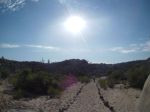
Somewhere in the Vizcaíno Desert in Baja California, Mexico…“I found a rattlesnake!” someone yelled out.  Several individuals I had been standing with disappeared, running in the direction of the the creature.  Not a huge fan of snakes I continued perusing the desert landscape alone.  It was not at all what I expected when I had chosen to travel to Baja.

I pictured a monochromatic brown landscape of cracked earth, sparsely populated with lone scrubby bushes or cacti, and dust balls rolling across it’s surface.  What I found was a lush colorful landscape.  There were yellow and purple flowers, green cacti of every variety (and spike) imaginable, and palm trees.  There were mountains, birds, lizards, and…apparently snakes.  The view went on forever.

My journey to this place in the middle of the desert with 20 strangers began in East Harlem, New York where I live.  I was looking for a job working with wildlife or the environment when I happened upon a website for the Global Field Program with a group called Project Dragonfly and a school called the University of Miami.  I flipped from page to page, this is what I wanted.  This was my dream.  I signed up and made plans to travel from Manhattan, New York to San Diego, California.  There I would meet up with 20 other adventurers bound for Baja California, Mexico.

My home is one of the most populous cities in the world.  It is an island about 12 miles long and 3 miles across.  I share it with about 1.6 million other people.  In the 12 years I’ve lived here I’ve grown used to the people, the noise, the trash, the concrete sidewalks, the glass and brick buildings, and the metal gates, grates and trains.

In the desert as I was left alone I let my senses absorb the change in scenery.  There were no people.  No noise.  No traffic.  No concrete.  No glass or brick buildings.  No metal trains careening through tunnels packed with passengers in a rush to get from here to there.  Just a group of 20 people who two days before had been strangers but now were friends.

This place made me hopeful that there are places left in the world worth saving.  It hasn’t all been paved over, cut down, or polluted.  And that there are people that can do it.

When a rattle snake sheds its skin, it also gains a rattle.  That is the best way to sum up the shift in my perception.  I left the desert feeling like I had shed something that was dead and I no longer needed, but also gained something that would help me in my journey forward.

This is a quote by one of my favorite musicians I discovered when I returned from Baja and I feel like it really captures the feeling that I had before and after the trip.